📸 A Kodak Moment All Over Again: How Canon, Sony, Nikon, and Others Missed the Action Camera Revolution
- gear4greatness
- May 1, 2025
- 4 min read

Updated: Nov 14, 2025
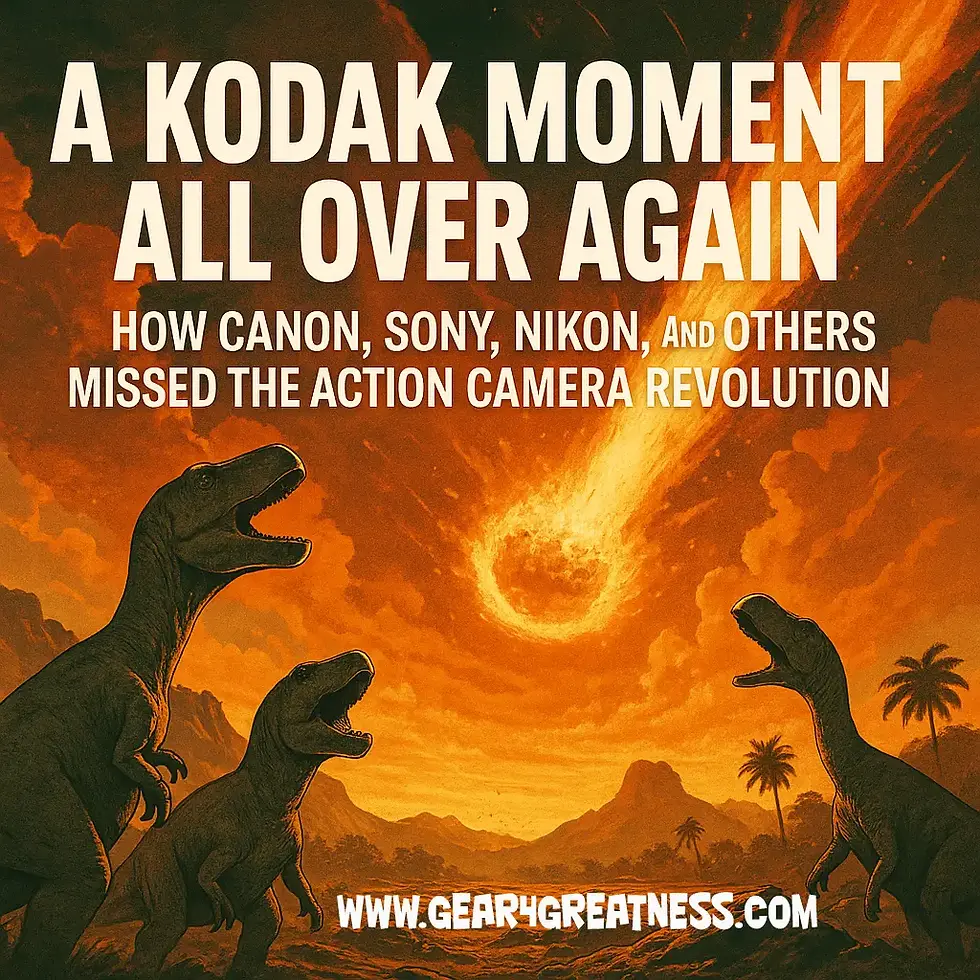
📸 A Kodak Moment All Over Again: How Canon, Sony, Nikon, and Others Missed the Action Camera Revolution
It’s wild watching history repeat itself right in front of us. 📉📸 Every time I see Canon or Sony drop another “incremental mirrorless update,” I can’t help thinking back to Kodak — a giant that helped invent the digital camera but still refused to believe the future was already happening. Now here we are in 2025, and the same movie is playing again… except this time the names are different, and the creators are the ones walking out of the theatre early. Because while the old guard sleeps, GoPro, DJI, and Insta360 are sprinting into the spotlight like they’ve been waiting for this moment their whole lives. 🚀🔥
I’m out there filming bike rides, city walks, sunrise POVs, cat zoomies, and spontaneous golden-hour reflections — and every time, I’m using cameras built by companies that actually get what living in 2025 feels like. Cameras I can wear, dunk in water, strap to a bike, toss in a pocket, or mount to a sunroof without worrying they’ll die or overheat. Meanwhile Canon, Nikon, Panasonic, and Sony are still arguing about DSLRs, RF lens roadmaps, outdated body sizes, and menu tweaks. It’s like watching someone polish a VHS tape while the rest of us are livestreaming in 4K. 📼➡️📱
And the thing that gets me? They had every opportunity to own this market. Canon’s Dual Pixel AF could’ve been the brain of the greatest pocket cam ever made. Sony’s stabilization and sensors could’ve powered a GoPro killer. Nikon could’ve reinvented the KeyMission instead of letting it sink. Panasonic could’ve shrunk Lumix magic into something waterproof and wild. But none of them showed up. None of them moved. And creators don’t wait — we adapt. We grab whatever tool helps us move faster, film freer, and feel more connected to what we’re capturing. 🎥⚡
Somehow, the one traditional brand that didn’t face-plant was Leica — and honestly, it still surprises me. Leica could’ve stayed in their luxury bubble and faded into “remember when?” nostalgia. Instead, they teamed up with Insta360 and built something fresh. The Ace Pro line feels like this weird but beautiful bridge between old optical craftsmanship and new creator-first thinking. The Summarit lenses, the color tuning, the image feel — you feel the Leica soul in these tiny action cams. 🔴✨ It’s the one example of a legacy brand adapting instead of digging in its heels, and it shows what’s possible when pride doesn’t get in the way of evolution.
Meanwhile, the misses just keep stacking up. Olympus has rugged cameras but nothing wearable or AI-smart. Fujifilm makes magic for photographers but doesn’t touch the creator-first space. Pentax is stuck in the past. Samsung left years ago. Zeiss and Sigma are watching from the sidelines. The world has gone vertical, mobile, waterproof, pocket-sized, and AI-accelerated — and somehow the giants who built the foundations of modern imaging can’t keep up with the ones who used to be considered “niche.” It’s surreal. 🌍🔄
📸 A Kodak Moment All Over Again: How Canon, Sony, Nikon, and Others Missed the Action Camera Revolution
🌄 Final Thoughts
Some days it honestly feels like I’m watching two different industries. One is alive — buzzing with innovation, motion, creator energy, and tools that respect the way we actually live and film. The other feels frozen in time, trapped by tradition and terrified to take risks. And the more I shoot with POV rigs, compact gimbal cams, or 360 setups, the more obvious the gap becomes. The gear that moves with you — that disappears into your moment — is the gear the next decade belongs to. Creators don’t want a camera to babysit anymore. We want a camera that keeps up. 🎥💨🔥
What Leica did with Insta360 is a perfect example of choosing humility over ego, collaboration over competition, and future over nostalgia. It proves that legacy doesn’t have to mean stagnation. It can mean evolution. It can mean reinvention. And honestly? It can mean survival. When I film a hyperlapse downtown or a sunset over Winnipeg, I’m reminded how far ahead these creator-first companies are — not because they have better engineers, but because they listened to the people who use their cameras every day. They paid attention. And they built for us. 🌆💛
Canon, Sony, Nikon, Panasonic — these brands still have brilliance in their DNA. They still have the power to turn the tide if they’d just lean into what creators actually need. But time is not kind in tech. You can’t coast for a decade and hope passion carries you. I don’t want these companies to fail — I grew up shooting their gear — but I can feel the market shifting under them. And the truth is, creators have already moved on. Once people discover freedom — waterproof freedom, wearable freedom, AI reframing freedom — they don’t go back. 🚴♂️🌊📱
If these giants want to avoid becoming the next chapter in the Kodak cautionary tale, they need to wake up and step into the world creators are already living in. Not next year. Not “in development.” Now. Because the gear that adapts to the creator — not the other way around — is the gear that will define the next decade of storytelling. And honestly? I’m here for it. 🌍✨


Comments