Premium Mini LED TVs: What Does Paying More Actually Buy?

Affiliate disclosure: As an Amazon Associate I earn from qualifying purchases. Gear for Greatness may receive a commission through the links below, at no additional cost to you.
Quick verdict
Premium Mini LED TVs are worth considering when better light control, reflection handling or HDR presentation solves something you actually notice. For everyday television, a good midrange model can be the better buy. The new RGB and SQD labels describe different engineering approaches; they do not establish a universal winner.
This is a research-based buying guide using the manufacturer and standards sources linked below. It does not claim hands-on testing or original performance measurements. Cover artwork is an AI-generated concept illustration of a viewing setup, not a photograph of a tested product; the separate diagram explains the buying decision.
What stays the same
A Mini LED television is an LCD television with a backlight made from small LEDs. The LCD pixels form the picture while the backlight supplies illumination. Improving that backlight can improve the image, but it does not turn the screen into a display where every pixel makes its own light.
That distinction explains both the attraction and the limitation. Bright highlights and large screen sizes can be appealing, while a bright object beside darkness still challenges the combination of LCD panel, optics and dimming zones. Paying more should buy a visible improvement in the content you watch, rather than simply a more impressive badge.
Better dimming: the difference to look for at night
Local dimming changes the illumination in different areas. More independently controlled zones can allow finer control, but the algorithm and the way light spreads through the screen matter too. Sony describes its Mini LED system in terms of both the LEDs and their control, which is why counting zones alone is an incomplete comparison.
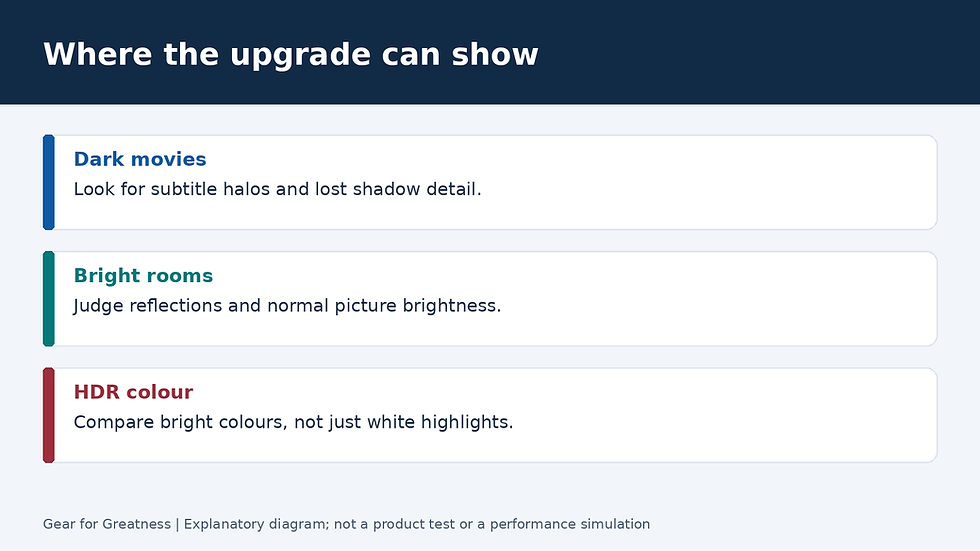
Use a familiar dark scene with subtitles. Look for a halo around the letters, sudden changes as they appear, and clothing or scenery disappearing into black. An apparently darker picture is not automatically better if it hides information. Compare from your normal seat and from the side seats your household uses.
RGB, Micro RGB and SQD: three names worth decoding
RGB Mini LED uses red, green and blue light sources in the backlight. Samsung calls its approach Micro RGB. SQD is TCL’s Super Quantum Dot approach, which develops the quantum-dot and filter system while retaining blue Mini LED backlighting. Both are routes toward improved colour performance in LCD televisions.
Micro RGB must not be confused with self-emissive MicroLED. Samsung explicitly distinguishes the two. Also avoid assuming that every expensive Mini LED TV is RGB: TCL markets SQD and RGB designs separately. Read the exact regional model page rather than applying one brand’s terminology to another.
Design | Light source | What to compare |
QD Mini LED | Mini LED backlight and quantum dots | Dimming, brightness and whole-TV performance |
SQD Mini LED | Blue Mini LEDs with advanced quantum dots and filters | Colour accuracy plus the complete LCD system |
RGB / Micro RGB | Separate red, green and blue backlight emitters | Colour performance plus dimming and reflections |
What brightness figures leave out
TCL’s US comparison lists series maximums of up to 3,000, 6,000 and 10,000 nits for QM7L, QM8L and X11L respectively, and explicitly says figures vary by size. These are manufacturer claims, not measurements made for this article. They are not full-screen sustained brightness ratings.
A brief bright highlight occupies a different part of a scene from an afternoon hockey broadcast. For daylight use, ask how the television handles your window reflections and ordinary programme brightness. For HDR movies, examine whether bright detail remains visible instead of becoming a flat white patch.
Who should buy, and who should skip
Consider the upgrade if dark-room halos bother you, daylight reflections interrupt viewing, or you regularly watch good HDR sources and can see an improvement in a fair comparison. Treat better processing, side-seat performance and usable gaming ports as separate benefits that need checking on the exact model.
Skip the premium if you mostly watch routine broadcasts from a distance, already like your television, or would have to sacrifice a comfortable screen size and delivery budget to get it. A flagship cannot restore detail absent from a poor source. It also cannot fix a room layout that puts a window directly in the reflection.
Best value and final choice
Start with a capable midrange Mini LED television in the right size. Compare it with the premium alternative using the same source, a comparable accurate picture mode and your likely room lighting. Check a dark film, a bright programme and something with faces; showroom demonstration loops answer a narrower question.
Pay more only when you can name the improvement and expect to use it. The strongest reason to upgrade is a better picture in your actual viewing conditions. If the improvement is small to your eyes, keep the difference for sound, suitable installation or simply the household budget.


Comments