Sonos Sub Mini vs Sub 4: Which Fits Your Room and System?

Affiliate disclosure: As an Amazon Associate I earn from qualifying purchases. Gear for Greatness may receive a commission through the links below, at no additional cost to you.
Quick verdict
Choose Sub Mini when its compact enclosure, compatible system and moderate listening needs line up. Consider Sub 4 when you want the larger subwoofer design and its placement flexibility. Check compatibility first, and do not use a single frequency-response number as a complete performance ranking.
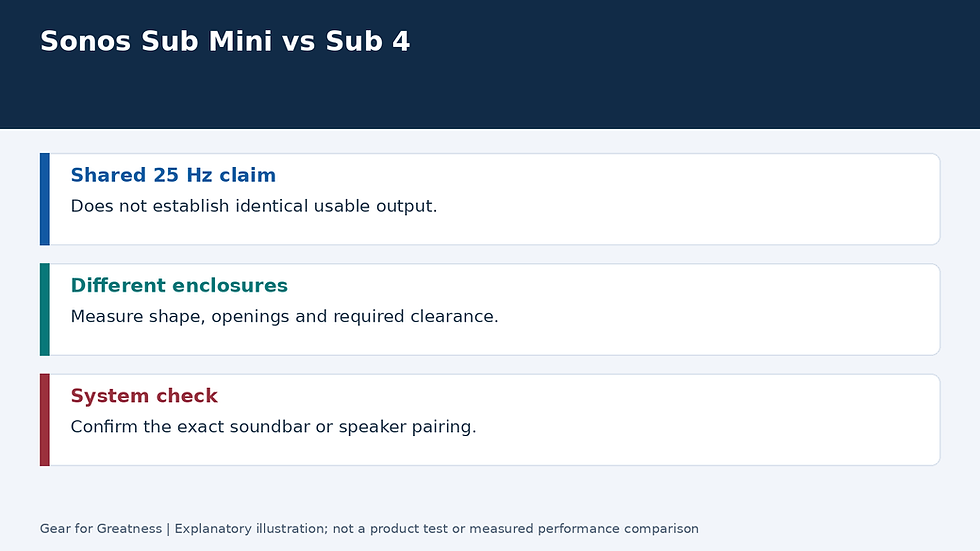
This comparison uses the manufacturer sources linked below and practical buying criteria. It does not claim a controlled hands-on test or original performance measurements. Cover artwork is an AI-generated concept illustration, not a photograph of a tested branded product; the separate graphic explains the decision.
At a glance
Specification | Sub Mini | Sub 4 |
Cabinet | Sealed cylindrical enclosure | Ported enclosure |
Published dimensions | 305 × 230 × 230 mm | 389 × 402 × 158 mm |
Published extension | As low as 25 Hz | As low as 25 Hz |
The same extension claim does not mean the same output
Sonos publishes an as-low-as-25-Hz claim for both models. That does not establish identical output capability, distortion or performance in a particular room. A lower frequency limit and the amount of sound available at that frequency are different pieces of information.
The Sub Mini uses a sealed cabinet, while Sub 4 uses a ported design. Treat those as documented architecture differences. This guide does not turn them into an invented measurement of how much louder one will play in your home.
Shape can decide the practical winner
The Sub Mini is taller than its 230 mm circular footprint suggests; Sub 4 is broader but relatively slim. Measure the whole enclosure and the intended route to power. A product photograph beside an unusually large sofa is a poor substitute for dimensions.
Check the permitted orientation and clearance for the exact model. Sub 4 can support more than one orientation, but that does not mean either product should be squeezed into any available gap. Keep the required openings and setup access clear.
Choose within a compatible Sonos system
These products are system add-ons, not universal subwoofers with a generic input for any powered speaker. Use Sonos’s current compatibility information for the exact soundbar or speaker you own, and consider any older-app limitations.
Do not assume an upgrade plan works because both boxes carry Sonos branding. If you are changing the main soundbar too, cost the complete intended combination before deciding which subwoofer looks like the cheaper step.
Who should buy, who should skip
Sub Mini is attractive for a compact compatible setup where a smaller enclosure is useful and cinema-scale bass is not the main objective. Sub 4 deserves a comparison when low-frequency output is a priority and its broader cabinet fits comfortably.
Skip either purchase until you have tried the main system at normal listening levels. If the missing element is dialogue clarity, a subwoofer may not address the problem directly. Adjust the relevant sound settings before buying more bass.
Best value and final choice
Start with the least costly compatible model that meets your real needs. Pay more for a larger-system goal, useful orientation choices or a demonstrated improvement, rather than assuming that all rooms need the largest option.
After setup, use a familiar film and music track to set a balanced level. A subwoofer should integrate with the system rather than becoming the only thing you notice. That judgement matters more than matching one line in a specification table.


Comments