Godox AD200ProII vs AD300ProII: Modular Pocket Flash or Monolight?

The Godox AD200ProII vs AD300ProII comparison is a choice between a modular pocket flash and a compact monolight. The difference is more useful than simply ranking 200Ws below 300Ws. This buying guide draws on manufacturer information and focuses on the complete lighting setup; it does not report hands-on measurements.
As an Amazon Associate I earn from qualifying purchases.

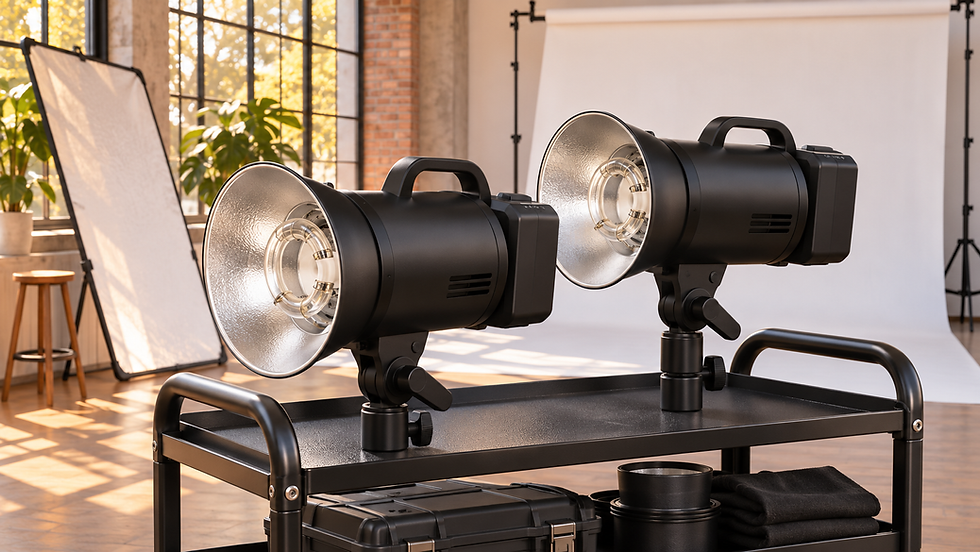
Illustration with generic portable lights; not exact product photographs or a size measurement.
Quick verdict
Choose the AD200ProII if interchangeable heads are central to your kit. Choose the AD300ProII if you prefer a compact monolight with more maximum energy and a stronger bi-colour modelling-light option. Check your modifier connection before placing an order.
At a glance
Make the head design the first decision
The AD200ProII is useful when you want to change the way the flash emits light by swapping heads. Its speedlight-style and bare-bulb options serve different modifier arrangements. That flexibility can reduce the need to buy another body when your lighting approach changes.
The AD300ProII is attractive when you want one compact monolight format that stays assembled in a predictable way. For a photographer who always uses the same softbox, fewer head decisions can be convenient. Compare packed space and assembly time, rather than assuming modularity is always an advantage.
Judge the extra energy in the intended setup
Moving from 200Ws to 300Ws provides additional maximum flash energy. It can be helpful when a modifier absorbs light or the stand must be placed farther from the subject. It does not promise a specific measured exposure increase across different heads, reflectors and softboxes.
If your current light already works comfortably below full power, the energy increase may change less than expected. If you often reach its limit, write down the aperture, distance and modifier that cause the problem. That gives you a more useful purchase target than a general desire for a stronger flash.

Check the mount instead of assuming Bowens fit
The AD300ProII has a Godox mount. A Bowens softbox should not be treated as a direct attachment without the appropriate adapter or bracket arrangement. The official manual describes additional adapter options; confirm the exact accessory required for your modifier and the items included in the listing.
The AD200ProII also needs the appropriate bracket for a Bowens-style setup. Include that hardware in the weight, cost and bag-space comparison. A larger softbox can make the complete kit much more substantial than either bare flash body suggests, especially when you also carry a stand and support hardware.
Use the modelling light for its intended role
Godox specifies a 12W bi-colour modelling light for the AD300ProII. That can help with previewing direction and shadow placement in suitable ambient conditions. It is a separate capability from the short flash burst used to expose the photograph.
Do not assume a modelling lamp replaces a dedicated continuous video light or that it will be equally visible outdoors in bright daylight. If hybrid photo and video work is the main purpose of the purchase, evaluate continuous-light output independently instead of treating flash watt-seconds as a video-light rating.
Build a compatible radio and battery routine
Both lights use Godox X radio receiving. Choose a camera-compatible transmitter and verify TTL, high-speed-sync and firmware support for the combination you intend to use. A shared radio system does not guarantee every camera-specific feature without the right trigger.
Check the exact II-generation model, supplied battery, charging equipment and warranty. Manufacturer recycle times are conditional, and fast sessions can place different demands on the kit than occasional portraits. Decide whether a second battery, simpler modifier or another small fill light would improve your work more than the change of body.
Final choice
Choose the AD200ProII for head flexibility in a pocket-flash system. Choose the AD300ProII for a compact monolight workflow, 300Ws ceiling and 12W bi-colour modelling lamp. Confirm the modifier mount and compatible trigger as part of the same buying decision.
Sources and further reading
Related buying guide
For the smaller-light decision, read Godox AD100ProII vs AD200ProII.


Comments