Godox MS300V vs SK400IIIV: Which Home Studio Flash?

The Godox MS300V vs SK400IIIV comparison is for photographers building a studio around mains-powered manual flash. These are different purchases from battery location lights or automatic on-camera TTL flashes. This manufacturer-source buying guide focuses on energy, minimum output and the complete home-studio setup rather than hands-on test claims.
As an Amazon Associate I earn from qualifying purchases.

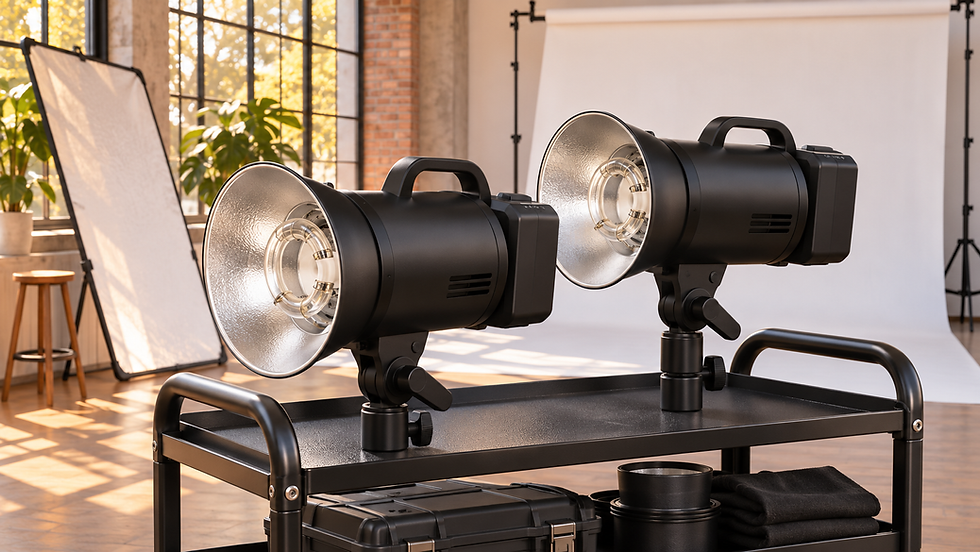
Illustration of generic studio flashes and a tabletop setup; not exact product photographs.
Quick verdict
Choose the MS300V when a 300Ws manual light meets the needs of your room and modifiers. Choose the SK400IIIV when you have a reason to want a 400Ws ceiling. For close tabletop work, check minimum usable output before assuming the stronger light is the better choice.
At a glance
Start with the room and the subject
A small product table and a full-length portrait setup make different demands on a flash. For objects close to a large softbox, you may spend more time reducing output than seeking maximum power. For a larger subject or a modifier positioned farther away, the higher ceiling may become useful.
The difference between 300Ws and 400Ws is additional energy, not a promise of a dramatic transformation in every photograph. Reflectors, diffusion layers and distance affect the light reaching the subject. Choose around the actual setup rather than treating a larger model number as a complete buying argument.
Do not overlook the minimum power setting
Both specify a 1/32 minimum relative to their own maximum output. That means the same fraction on the display does not represent the same absolute stored energy on the two lights. A stronger maximum can also mean more energy at the minimum setting.
This matters when you want a wide aperture, a close light or photographs of a small reflective object. You can change distance or add suitable diffusion, but those changes can also alter reflections and light quality. Think about your lowest-output use case as carefully as your most demanding full-power shot.

Buy the correct regional mains version
These lights depend on external AC power. The manuals describe regional voltage versions rather than a universal-input promise. For ordinary USA or Canadian mains use, confirm the appropriate 100–120V version and suitable supplied power cord with the seller.
A plug adapter alone does not establish voltage compatibility. Read the rating on the exact unit or listing and confirm it matches where you will use it. If you need regular outdoor operation without reliable mains power, a battery flash may be a more suitable purchase than assembling an improvised travel-power arrangement.
Understand what the radio system adds
Built-in Godox X receiving can simplify remote firing and manual output control with a suitable transmitter. It does not turn these manual studio units into TTL flashes. Do not assume high-speed sync is available simply because the transmitter offers that setting for other compatible lights.
Confirm the transmitter's camera compatibility and the normal flash-sync behavior of your camera. For a fixed tabletop scene, manual output is often straightforward: establish the exposure, keep the distances consistent and adjust individual lights deliberately. A more expensive automatic mode is not required to make a repeatable studio photograph.
Compare complete studio kits and exact generations
Confirm the modifier mount, stand, reflector and any accessories supplied in the specific bundle. An inexpensive flash body can become a less attractive purchase if the kit omits the support or modifier you need. A suitable stand and manageable softbox are part of the working system.
The SK400IIIV is distinct from the older SK400II and SK400IIV, while MS300V is distinct from MS300. Check the exact suffix on the listing and delivered equipment. Compare local warranty support and replacement-part availability as well as the body price, especially if the lights will support regular paid product work.
Final choice
Choose the MS300V for a defined 300Ws mains-powered studio role. Choose the SK400IIIV when the additional energy is useful and its minimum output still suits the room. Confirm regional voltage, exact generation and the full modifier-and-stand kit before buying.
Sources and further reading
Related buying guide
For battery-powered alternatives, read Godox AD600ProII vs AD600BMII.


Comments