Godox AD300ProII vs AD400ProII: Carry Less or Add Headroom?

The Godox AD300ProII vs AD400ProII decision is a useful checkpoint before a portable lighting kit becomes heavier than it needs to be. The AD400ProII offers more flash energy and a stronger modelling lamp, while the AD300ProII is the smaller carrying proposition. This guide uses manufacturer specifications, not measured hands-on results.
As an Amazon Associate I earn from qualifying purchases.

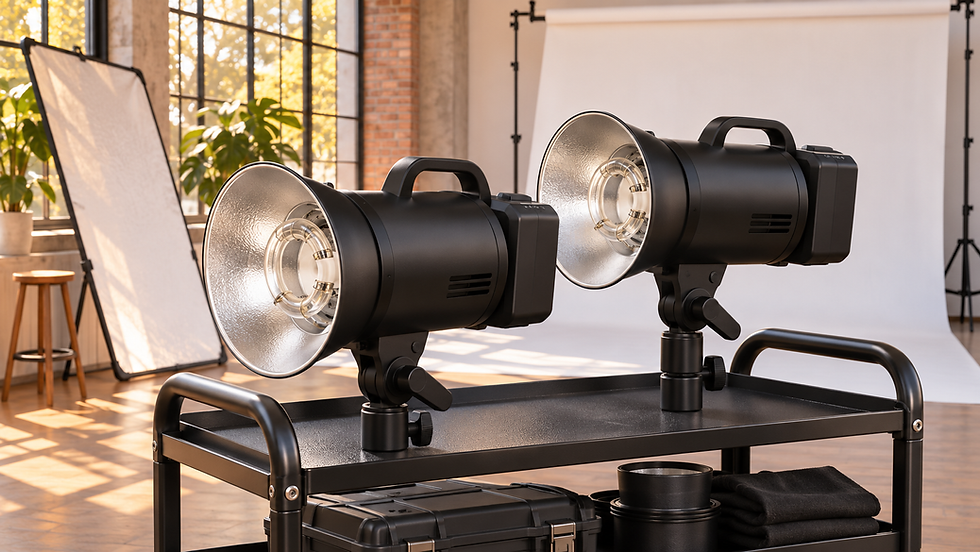
Illustration of generic lighting equipment; not exact product photographs or a scale comparison.
Quick verdict
Choose the AD300ProII when a lighter one-person kit is the priority and 300Ws is sufficient. Choose the AD400ProII when its 400Ws ceiling and 30W modelling lamp have a clear purpose. Compare total kit weight and modifier connections, not just the bare lights.
At a glance
Consider the whole journey to the portrait location
If you carry the kit alone from a car park to a portrait location, the smaller AD300ProII has an obvious practical appeal. The official weight descriptions use different accessory exclusions, so the numbers should not be treated as a perfectly matched ready-to-shoot weigh-in. Add the hardware you will actually take.
A heavier light is easier to justify when you work close to a vehicle, have assistance or use it mainly in a fixed studio. Include the stand, modifier, spare battery and camera bag in the comparison. The flash body is only one part of what ends up on your shoulder.
Buy extra energy to solve a defined limitation
The AD400ProII raises the maximum energy from 300Ws to 400Ws. That provides additional room for a light-absorbing modifier or a greater working distance. It does not guarantee a particular exposure advantage across different reflectors and softboxes, and it is not a doubling of flash energy.
If you normally work below full power, the extra ceiling may be less valuable than another well-placed light. If you regularly hit full power and still cannot use your intended aperture, the larger unit has a clearer role. Start with that specific problem before deciding to carry more equipment.

Treat modelling light as a separate feature
The 30W bi-colour lamp is a distinct reason to consider the AD400ProII. The AD300ProII's lamp is rated at 12W, and both list a 2800–6000K adjustment range. A modelling lamp can help you see the direction of shadows and refine a portrait setup in suitable ambient conditions.
Lamp wattage is not a measured brightness comparison through every modifier. Nor should either lamp be assumed to replace a dedicated video light. If continuous-light work matters, check the relevant output information and your working distance separately from the flash-energy specification.
Check the modifier and radio arrangement
The AD300ProII uses a Godox mount; other modifier systems require the appropriate adapter or bracket. For either light, verify the exact mount arrangement and included accessories for the softbox you own. Do not buy from the model name alone and discover later that the required connection is missing.
Both receive Godox X radio commands. Choose a transmitter made for your camera system and confirm body-specific TTL and high-speed-sync support. Match the channel, wireless ID and group before the shoot. A common radio ecosystem does not make every transmitter hot shoe interchangeable across camera brands.
Compare the upgrade with keeping a balanced kit
Keeping a smaller main light and adding a reflector or compact fill light can be a sensible approach when the exposure requirement is already met. A larger main light is more attractive when you need one unit to do a demanding job. Choose around the images you produce, not the highest number in the range.
Check for the exact ProII generation, local warranty, supplied battery and charging equipment. Manufacturer recycling figures describe specified conditions and may change with settings and thermal demands. Your purchase decision should include how you will charge, pack and set up the kit between real sessions.
Final choice
The AD300ProII is the better fit for a lighter kit that already has enough output. The AD400ProII earns its extra size when the 400Ws ceiling or stronger modelling lamp solves a recurring need. Confirm the complete modifier and trigger setup before buying.
Sources and further reading
Related buying guide
For the smaller modular option, read Godox AD200ProII vs AD300ProII.


Comments