Godox V860III vs V1Pro: Zoom Head or Round Head?

The Godox V860III vs V1Pro comparison is mainly a choice of head design and accessory workflow. Both offer rechargeable power, TTL with the correct camera version and access to Godox's X radio system. This manufacturer-specification buying guide explains where the differences matter without claiming hands-on performance testing.
As an Amazon Associate I earn from qualifying purchases.

Illustration using generic camera flashes; these are not exact product photographs.
Quick verdict
Choose the V860III for its rectangular zoom head and broader stated zoom coverage. Choose the V1Pro for a round-head setup and detachable SU-1 secondary flash. A V1Pro upgrade makes most sense when those features fit how you light people.
At a glance
Choose the head for your actual lighting
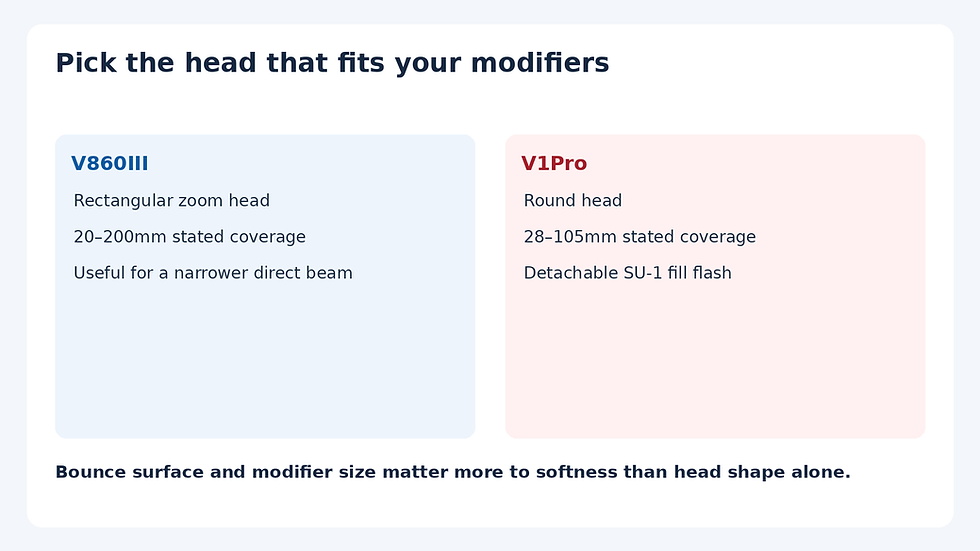
The V860III's 20–200mm range gives you more scope to narrow its beam when the flash is used directly or as a targeted off-camera light. That can be helpful when you want light on a small part of the frame. The zoom setting describes coverage; it does not change the focal length of your camera lens.
The V1Pro takes the round-head route. That is attractive for photographers building a compact set of round-head accessories, but a circular beam is not automatically softer light. Shadow softness still depends heavily on the apparent size of the source and its distance from your subject.
Consider bounce flash before comparing accessories
For indoor events, both flashes can be aimed at a suitable wall or ceiling. A nearby neutral surface often has more influence on the result than the head shape. Dark timber, coloured walls and very high ceilings can change the result or leave too little useful light reaching the subject.
The V1Pro adds the removable SU-1 sub-flash, which can introduce frontal fill while the main head is bounced. Buy it because you want that particular option, rather than assuming you must use it for every portrait. Check reflections in glasses and shiny surfaces when adding direct fill.
Plan the modifier system
Start with the modifier you expect to use most often: a bounce card, a small grid, an umbrella or a larger softbox. Confirm the exact accessory attachment and any required adapter. A listing for a round-head accessory kit should not be assumed to fit a rectangular flash head directly.
For an off-camera umbrella or softbox, include the bracket, stand and compatible transmitter in the budget. A head-design upgrade may matter less once the flash is inside a larger modifier. If your current V860III already works with your bracket, retaining that setup can be the practical choice.
Match camera compatibility before buying
Choose the model suffix for your camera system and consult the manufacturer compatibility downloads for your particular body. TTL and high-speed sync depend on the camera, flash version and settings. Do not select a Sony, Canon or Nikon listing simply because it has the lowest displayed price.
The shared Godox X radio system makes these useful beyond the camera shoe. You still need to configure the channel, wireless ID and group correctly. Check that the chosen transmitter supports the features you need on your camera; radio communication does not make every hot shoe universally compatible.
Spend on the part that changes your work
When comparing kits, check batteries, charger, accessory bundles and local warranty support. Published recharge and flash-count figures describe specific manufacturer conditions; they do not predict how many usable wedding photographs you will take. Power level, burst pace and battery condition all affect a working session.
For occasional portraits, better light placement and a suitable modifier may be the stronger investment. For regular event work, choose the flash you can operate confidently with one hand on the camera. There is little benefit in a feature that slows you down or stays in the bag.
Final choice
The V860III is the straightforward choice for photographers who want its wider zoom range and rectangular head. The V1Pro is the more purposeful purchase for a round-head accessory workflow and secondary fill option. Buy the compatible camera version and compare complete kits.
Sources and further reading
Related buying guide
For the next round-head option, read Godox V100 vs V1Pro.


Comments